The first University of Santo Tomasstamps were issued in 1956 to commemorate the 350th anniversary of the institution, which was founded on April 28, 1611. So the stamps came out five years early. A veteran dealer explained that a UST rector, an avid philatelist, could not wait till 1961 and wanted to see a set of stamps for the University.
The 1956 UST set is beautiful. They are engraved.
Then in 1971 another UST set was printed, to commemorate the 100th anniversary of the Colleges of Medicine and Pharmacy.
1971 set
1971 UST set on First Day Cover
The UST Colleges of Education and Science both celebrated their 50th anniversary in 1976, when another commemorative set was issued. I remember going to the Main Building (I was a Mechanical Engineering student then) and buying some sets which my meager allowance could afford.
1976 set
In 1988, the UST Graduate School celebrated it's 50th anniversary and the Bureau of Post issue this single in sheets of 100 and mini sheet of 6.
1988 UST Graduate School mini sheet
This month, January 2011, a Block-of-4 set and a souvenir sheet were printed to commemorate UST's 400 anniversary.
The dewdrops of nature, like billions of eyes, each looks at the same world, but none in exactly the same way. We appear in nature in the same manner, different to every beholder.
It is the particular penalty of those who pursue strange butterflies into dark forests, and go fishing in enchanted and forbidden streams. -- H.L. Mencken, The Divine Afflatus
Time you enjoyed wasting was not wasted. -- John Lennon
Obviously Google Ads can't make heads or tails of what I inflict on this site. Looking at the right margin of this page, I always see ads about Jesus -- the history of his death, how he loves you, ad infinitum (unintended but good pun); also two ads about God, at least mitigated by a topic I can tolerate -- "Is there life after death?" (It's a big yes for Jesus.) But I hate it when they mix religion with astronomy, The Big Bang, and DNA. Having mentioned key words like Jesus and God here, I'm sure those Google Ads will remain. At least the bottom ad, like "Have fun killing flies," provides fun and relief. Still, this reinforces my observation that Google Ads is lost as far as my way of thinking is concerned.
Hehehe.
Suppose I discuss John Lennon here? Will Google read this and post some ads about him and the Beatles? We will not know unless I try, huh? Well, here we go:
Recently, taking a break from Ishmael's whale and Pip's great expectations, I pored through The Beatles Anthology, a big, heavy and costly book (it's worth the money, by the way), and read some pages about Lennon. This, naturally, tickled some molecular brain cells, which quickly pulled out from dusty drawers of memory random tidbits about him, his songs, his opinions about music, and his attitude toward life.
For example, Lennon was not sure about the merit of the lyrics he wrote for Across The Universe, although he obviously loved it. In a Playboy interview in the January 1980 issue, he said he is leaving judgment to posterity.
Words are flying out
like endless rain into a paper cup
They slither while they pass
They slip away across the universe...
Thoughts meander like a
restless wing inside a letter box
They tumble blindly as
they make their way across the universe.
Lennon had in separate instances expressed great fondness for the lyrics of this song, but he was going through a bad time then and had lost the confidence essential to an artist's ability to create good stuff.
And like many inheritors of the Great Craft, he sometimes borrowed from the old masters. Because, which appeared in the Abbey Road album, was based around the chords of Beethoven's Moonlight Sonata, which Yoko Ono was playing on the piano one day. So I listened to the sonata, and, as Lennon pointed out, his song sounded like Ludwig's, too.
Close your eyes to the music and we are in 1801, the tormented master playing Piano Sonata inC♯ minor, imagine a woman, dressed in the fashion of the period, seated in the room and listening.Through the darkness outside the window, the moon is full, but the pavements can only be glimpsed by the feeble lights cast by the streetlamps...
Every streetlamp
seems to beat
a fatalistic warning...
And the past stretches to the present, where we find a Japanese woman playing the old song; her famous husband, lying on the sofa, asks her to play the chords backward. She does, and an improvised sonata makes it to the Beatles' last album.
In Lennon's interview that January 1980, he remarked, "...And come to think of it, it looks like I'm going to be 40 and life begins at 40 -- so they promise. And I believe it, too. I feel fine and I'm very excited. It's like, you know, hitting 21, like, 'Wow, what's going to happen next?...'"
What happened next was that he celebrated his 40th birthday on October 9 that year, and before the year was out, four bullets snuffed out his life in New York on December 8.
Namimilipit na ba kayo sa taas ng bayad sa kuryente, LPG at iba pang may kinalaman sa energy consumption? Kung gano'n basahin itong solusyon ni Anna -- sabay ilag! He he he...
Fifty years after the end of WWII, the US Postal Service planned to include a picture of the Hiroshima bomb as a historic event in a souvenir sheet commemorating the end of the war. However, due to objections from Japan, followed by pressure from the White House, the design was replaced with a picture of President Truman announcing the end of war.
“Oy, oy, oy, Anna,” bunghalit ng MassCom titser ni Anna. “Ano’ng ibig sabihin nitong BNBNPP? Kung maglagay ka ng pamagat sa term paper mo parang knock-knock.”
“Ma’am naman. Iyan ang thesis ko sa energy problem: Biyaya Ng Bataan Nuclear Power Plant. Outline pa lang ‘yan, ma’am.”
“Naku, bata ka, kung magsulat ka parang di ka umiinom ng kape; di ka na ninerbiyos. Ayan at pumuputak na naman yang mga cause-oriented group at NGOs sa armageddon na idudulot niyang plantang iyan at sinasalungat mo pa. Sumapi ka na ba sa grupong BNPP na gustong makabalato sa kickback ng mga opisyales na gusto na namang buhayin yang planta?’
“Grupong BNPP? Ma'am, ha, bumabawi kayo. Pero sige, sirit na, ano ang BNPP mo?”
“Eh di Binayaran Na Peryodistang Palamunin. Kung anu-anong kahunghangan ang itinutulak nila para maduling ang taong-bayan sa depekto ng nuclear plant na ‘yan. At ikaw, Anna, ano namang biyaya ang ihihirit mo?’
“Eto, ma’am, namber wan, malulutas ng nuclear plant ang birth control isyu na pinagbabangayan lagi ng DOH at CBCP.”
“Kinakabahan ako sa kambyo ng utak mo, iha, pero sige, paki-ekspleyn lang kung ano ang connection ng DOH at CBCP sa nuclear plant sa Morong.”
“Beri simpol, ma’am. Kung matutunaw yung planta, automatic burado agad ang kalahati ng population natin, from 80 million to 40 million, at magiging warat na ang debate kung rhythm o rock-'n'-roll method ang mabisang birth control.”
“Ay wapen! Ba’t di ko naisip agad ‘yan. (Siguro dahil normal akong tao.) Eh ano naman itong pati poverty eh malulutas din ng BNPP?”
“Isipin mo, ma’am, karamihan sa mga Pinoy ay yagit. Ngayon, kung hahatiin mo ang population, di ba lalabas sa statistics na mas kokonti ang mga mahihirap ngayon kaysa noong hindi pa pinaaandar yung planta?”
“Aba, ang galing pala ng Westinghouse, hane? Ba’t di pa tayo magpagawa ng isa pang nuclear plant, diyan naman sa may Mt.Pinatubo, para wala nang pobre sa Pilipinas?”
“Oo nga, ma’am! Ang dami ko nang natutuhan talaga sa iyo! Mawawala na rin ang unemployment problem natin dahil magiging kaluluwa na lang ang mga walang trabaho rito. Kaya lang pati yung may trabaho matutunaw din. On the other hand, ang tinitingnan lang naman sa statistics eh yung unemployment rate, kaya tiyak gaganda ang figures ng NEDA diyan.”
“Heh! Nagbiro ako sinakyan mo na agad. Pero, according to your nakakahindik na thesis, bababa na rin yung crime rate dahil bababa na rin sa impiyerno ang mga criminal. For the same reason, mawawala na rin ang graft and corruption, prostitution, deforestation, pati na ang ating nation. Akalain mo nga ba namang pakyawan pala ang biyayang dulot ng nuclear meltdown, ano?”
“Yes, ma’am. Parang tutoo rin yung sinasabi ng mga backers niyang planta na makakatipid tayo sa kuryente. Imagine, pagputok niyang planta, yung hindi naging liquid metal sa atin eh hindi na kailangan ang Meralco at Napocor para magkailaw pa – dahil tayo na mismo, umiilaw! Yung mga taga-Bataan, ma’am, eh 100 watts siguro ang liwanag nila.”
“Ay, wa! Yung mga nasa Maynila 50 watts sila; at ikaw, Anna, dahil low-bat ka eh 25 watts ka lang. At ano naman ang karumal-dumal na mungkahi ng thesis mo?”
“Gawin nating industrial estate yung paligid ng nuclear power plant at diyan itayo ang mga pabrika at resthouse ng mga backer nitong BNPP, dahil iyon ay talagang lugar na pang-rest in peace, ‘ika nga. Kung gusto nilang piped-in music, siguro puwede yung Afterglow. Ano sa tingin niyo, ma’am?’
“Sa tingin ko’y radioactive na itong utak ko, iha. Haay, salamat at nag-bell na. Ano ba’ng susunod mong subject?”
“Psychology, ma’am. Si Dr. Hannibal Lecter ang professor ko. Ang galing-galing niya, ma’am! May thesis din ako para sa kanya!”
“Siyanga?! Naku, hindi lang pala ako ang suwerte sa araw na ito. Matutuwa sigurado iyon dahil magkakaintindihan kayo. Dali, puntahan mo at yayain mong mag-field trip sa BNPP.”
Stamp photos and caption from http://library.buffalo.edu/libraries/asl/exhibits/stamps/atomicbomb/
A bee, round and fat, hovered and dipped into a small flower in our garden. The garden, as I call it, was very small, but it was all the world to the bee.
I did not hear his buzz, but I did feel the contented peace that made the bee choose our garden as his sanctuary.
Outside, the muffled roar of jeepneys ferrying people to work intruded from time to time. It was still early morning, and globules of dew – to the bee’s consternation – still clung to the petals of the flowers.
The flowers, except for a few roses, are an ordinary lot, contributing their share of colors in small patches here and there. I don’t know if the bee was guided by the colors or by the nectar, but as it hovered and dipped into the flowers, I realized that I, too, discovered a patch where I could take refuge when things get a bit too rough outside.
The bee, as he bumbled in the garden, accommodated me. Perhaps he got used to seeing me there every morning. As the sun rose, bright but not too hot, we shared a patch of time when we did not have to hurry -- we had the leisure of existence.
I was a bit frightened: I thought things like these did not exist anymore.
But I know it willnot last; good things never do. The sun’s ray turns too hot and the bee has to go, taking his nectar with him. As with everything that lives, the bee is accountable to the price of existence -- Work.
In between books, I read quotations -- because I always encounter them in books written by great authors. The threads that connect great works I already noticed long ago. Here's what I stumbled upon recently:
As is the generation of leaves, so is that of humanity. The wind scatters the leaves on the ground, but the live timber burgeons with leaves again in the season of spring returning. So one generation of men will grow while Another dies. -- Homer, The Iliad
This is familiar. Ecclesiastes (1:4) rephrased it briefly but beautifully:
Generations come and generations go, but the Earth remains forever.
This got me thinking, which quotation came first? So, Googling Wikipedia, I got the following information:
"...the Iliad is among the oldest extant works of Western literature, and its written version is usually dated to around the 8th Century BC. The Iliad contains approximately 15,700 lines, and is written in a literary amalgam of several Greek dialects. The authorship of the poem is disputed."
And this:
"Some scholars believe much of the Old Testament was written in Mesopotamia [Now called Iraq -- Pogi]. It is believed the Old Testament was composed and compiled between the 12th and the 2nd Century BC..."
So either one could have been first, unless conclusive evidence is found to favor one or the other. Whatever. To continue: this line of thinking naturally leads to:
What has been will be again, What has been done will be done again; there is nothing new under the sun. -- Ecclesiastes 1:9
And whenever I get to Ecclesiastes, I always think of 9:11 --
I returned, and saw under the sun, that the race is not to the swift, nor the battle to the strong, neither yet bread to the wise, nor yet riches to men of understanding, nor yet favor to men of skill; but time and chance happen to them all.
Which simply means "Life is not fair," with the corollary, "May araw ka rin." Anyone with a fair amount of sensibility gets to realize this early or late in life. So I take to heart a quote from Ayn Rand's Atlas Shrugged: "We never had to take any of it seriously, did we?"
It seems Damon Runyon did not. This quote is attributed to him:
The race is not always to the swift, nor the battle to the strong—but that's the way to bet.
Hinahalughog ko ngayon yung mga malapit na bookstore para bilhin yung bagong edition ng UP Diksiyonaryong Filipino ni Virgilio Almario, aking gabay sa Tagalog o ang mas malawak na wikang Filipino.
Medyo atubili ako nang konti, kahit alam kong kailangan ko ito at bibilhin ko bandang huli.
Medyo nanlalamig lang ako pag nababasa ko yung mga inampon ng UP na mga banyagang salita, halos lahat mula sa English. Tulad ng "test" -- sa Filipino ng mga Filipino ni Rio Alma, inurirat pa niya kung ang tamang baybay nito ay "tes"; ang huling hatol ay hindi malalag yung huling "t." Ganyan din ang "k" sa "desk."
"Mayor" o "meyor"? Mayor. O, mas maigi, alkalde. Kung lasenggo si kagalang-galang, alakalde. Bise Presidente na si Jejemon Binay, pero laging Vice Ganda si la loca bongga. Major Major? Problema na ni Venus Raj yan.
Balik tayo sa yuping adhikain nitong mga tiga-UP. Ba't kailangang humiram habang meron naman tayong maayos na salita para sa test? Di pa ba sapat ang "pagsusuri" o "pagsusulit"? Ang tingin ko eh may pagsaalang-alang sa pagbigkas at sa paggamit.
"Marubdob na pagbati, kapatid, saan ang iyong patutunguhan?" (Oy, 'tol, sa'n ang lakad?) "Ala ey, may pagsusulit kami sa Agham at naantala ang dating ko; sige magkuro-kuro na lang tayo sansaglit." (Oy, brods, may Science test kami at late na ko. Kita-kitakits na lang tayo maya't tsika tayo.)
Kitam?
Ok, kung lalagyan natin ng konsiderasyon ang pang-araw-araw na gamit ng salita para hindi tila nagbabalagtasan tayo lagi, sige, test na kung test, blakbord na sa halip na pisara. Kung gano'n tanggapin na rin ang makabagong jologs, kapalit ng huklubang baduy, para hindi tayo ondoyin sa pagtutol ng mga bagets, dba?
May tututol dahil ang mga salitang ito ay nakasandal lang sa pagka-uso at kukupas din at dagliang maglalaho. Ganyan naman talaga kung buhay ang lengguwahe, may isinisilang habang may tumatanda na't nakakaligtaan hanggang pumanaw. Pero habang nand'yan si Lolit Solis, maaalaala natin ang bansag niya kay Kris na "pukengkeng"; hindi pa tsugi 'yan, mader.
Yung mga gumagamit pa ng Latin ay walang ganyang problema: dedo na ito, tsong, at dahil walang interesado masyado, di na paglalaruan ito. Turing ng Gen-X sa gurang na Latin ay paso na ito. Sa mga magpipilit na napakahalaga ng Latin para basta-basta na lang maglaho, dapat ding isipin na mahalaga lang ito dahil ito marahil ang ginamit sa mga biblia nu'ng unang panahon. Lumagapak yung Roman Empire at nasalin sa Old English ang biblia. Dito sa Pinas, nasalin ito sa Kastila, siempre.
Bakit napunta sa biblia ang usapan natin? Importante kasi ang relihiyon, at Latin ang ginagamit sa ritwal at misa noon (at ngayon). Kaya dapat panalatihing buhay ito dahil dinala nito ang salita ng Diyos at ikinuwento nito ang buhay ni Jesus? Aba, kung gano'n hindi dapat namatay ang Aramaic, yung gamit na wika ni Jesus at mga kakosa at kabarangay niya. Mas mabilis sigurong makalusot ang mga panalanging Aramaic kaysa English sa itaas. Pero ganyan naman tayo eh: pag may sinusuyo kumakambyo tayo agad sa English dahil parang walang lakas itong sariling wika.
"Quiet na baby; see the moon. Sleep na babyyy...jejomar (jesus, joseph, mary) you naman eh." Hesusmaryosep!
Pero meron pa ring nananalangin sa wika natin. Paano kung hihingi ka kay Lord ng iPad, laptop o touch-screen na cellphone? Balik na sa Taglish. May hinala akong mutant itong UP Diksiyonaryong Filipino at kahit pa'no eh aampunin ang mga salitang ito.
In di long ran Ay wil stil bay di UP diksiyonari, bekows Ay wil nat lern haw tu yus di lenggweyds en wil heb meydyor meydyor prablem in may layf.
Kung ano ang bigkas, siya ang baybay. Sa imahinasyon (pagkatopak) ko, ito ang lalabas sa wika natin kung unli ang paghiram natin ng imports. Jejeje.
***
Sumbong: Wala sa binagong edisyon na ito ang mga sumusunod na salita: Pusoy, Pusoy-Dos, Iwas-Pusoy, Yosi, Borloloy, Nenok, Bototoy, Budol-Budol, Ativan, Akyat-Bahay, Kakosa, Boga, Istokwa, Askal(asong kalye), Pusakal (pusa naman), Bondying, Kikiam, Dikiam, Sarao...
Iniisip ko kung paano isisingit angM-16, .45, GRO (parang LPG, spell out?), 8-Ball, 9-Ball.
Siguro makakatulong tayo kung may imumungkahi kayong mga salitang posibleng hindi pa rin naisali ng mga editor.
I will not be consoled by the misery of others. I will not be comforted while others suffer.
-- William the Henry
Sudan 1993: A vulture waits for a child to succumb to starvation caused by famine. This terrible picture won photographer Kevin Carter the Pulitzer Prize 14 months later.
Some scenes are so dreadful that they fuse themselves into my memory for life. This picture is one of them. It has receded into the recesses of my mind, overlapped by so many other images through the years, and then a seemingly unrelated link suddenly flashes this image and I am back in another time, another place, another life.
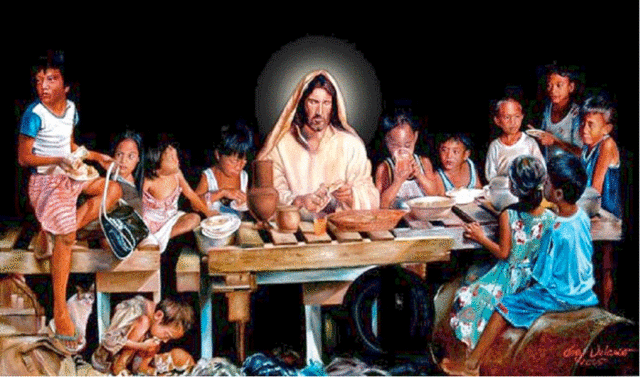
Last month a friend in Facebook uploaded a video titled Hapag ng Pag-asa, the Last Supper version of painter Joey Velasco. Instead of the apostles, street urchins surround Jesus. The video narrates the story behind each child, giving a name and life to each image in the painting.
The child huddled under the table was a representation of the dying girl in Carter's photograph. Through his art, Velasco saved Sudan, Joey's nickname for the the child in the painting, by giving him scraps of food. (Velasco thought the child was a boy, so a boy appeared under the table, so to speak.) The fate of the African child in Carter's photo was so tragic it threw Carter's mind into deep depression. In July 1994, two months after receiving his Pulitzer, Carter inserted a green garden hose to the exhaust of his red pickup truck and funneled the fumes inside. He died of carbon-monoxide poisoning, a suicide at the height of his career and fame. He was 33.
A note left on the passenger seat beneath a knapsack stated: "I'm really, really sorry. The pain of life overrides the joy to the point that joy does not exist."
Kevin Carter committed suicide near a small river,
in Johannesburg, where he used to play as a child.
I first saw Carter's photograph of the dying child on the now-defunct Daily Globe in 1994, when news of Carter's death was spread around the world. I was in Aguso, Mabalacat, Pampanga then, writing and editing for The Voice, a local tabloid owned and managed by Ody and Beth Fabian. I rewrote the Daily Globe story for the backpage of The Voice, snitching Carter's Pulitzer Prize-winning photograph. Then I composed a related editorial, about the role journalists play in world events and how some newsmen succumb to the pressures of the job.
Joey Velasco, the heARTIST, as he described himself, died of heart attack on 2010 July 20. He was 43. Like Carter's photograph, Velasco's legacy lives on.
If we leave an enduring gift to the world, we become immortal.
"My theory is that the human species is getting worse, not better. I believe, so to speak, in an evolution in reverse. The last man on earth will be both a criminal and a madman."
It's strange, I'm doing now what I shirked in my high school days: I'm doing a book report, in a lazy way, though. I just extract some portions of the book that leaves a deep impression on my way of thinking, to remind me of what the book is about and why it is important. My way is haphazard, whimsical, fun.
Books that used to bewilder me in younger days are now clear and friendly, their information flowing freely into my mind, informing, beguiling, prodding. If you are prepared, you get to understand and play the delightful game of life.
Sometimes I get some answers, and usually those answers lead to more questions. A never-ending thread that leads somewhere, to the indefinable last frontier if you pursue it long enough, if you last long enough. Great men have tried and failed. I don't even know how to begin.
To fully appreciate this 240-page novel, you must have gone through volumes on Philosophy (Singer quotes Spinoza and Schopenhauer); the Jewish, Catholic and other religions; World History ancient and modern, including World War II (particularly about the Holocaust); astronomy, biology and, of course, literature. If you are good in Math, it will be wasted here.
Since all the major characters in this novel -- Herman Broder and his three wives -- are survivors of the Holocaust, they provide a deeper look into what really happened in the Nazi concentration camps and into Stalin's equally murderous treatment of the refugees. Spielberg and Tom Hanks lifted part of the veil in Schindler's List, Saving Private Ryan, and Band of Brothers. Movies like The Pianist and Sophie's Choice added their share.
Anyway, here are some parts of the novel which impressed me.
"In Herman's private philosophy, survival itself was based on guile. From microbe to man life prevailed from generation to generation by sneaking past the jealous powers of destruction. Just like the Tzivkever smugglers in World War I, who stuffed their boots and blouses with tobacco... so did every bit of protoplasm, or conglomerate of protoplasm furtively traffic its way from epoch to epoch. It had been so when the first bacteria appeared in the slime at the ocean's edge and would be so when the sun became a cinder and the last living creature on earth froze to death, or perished in whichever way the final biological drama dictated."
"We leave traces of ourselves wherever we go, on whatever we touch." That's Thomas, combining mundane existence and small-scale biological observations.
"We are, perhaps, uniquely among the earth's creatures, the worrying animal. We worry away our lives, fearing the future, discontent with the present, unable to take in the idea of dying, unable to sit still." Vintage Thomas.
In turn, Singer points to a passage in Psalm: "Be gracious unto me, O Lord, for I am in distress. Mine eye wasteth away with vexation, yea, my soul and my body. For my life is spent in sorrow, and my years in sighing. My strength faileth because of mine iniquity and my bones are wasted away. Because of mine adversaries, I am become a reproach, yea, unto my neighbors exceedingly, and a dread to mine acquaintance."
Singer, speaking through Herman in the novel, observed: "How was it that these sentences fitted all circumstances, all ages, all moods, while secular literature, no matter how well written, in time lost its pertinence."
Only those who encountered danger and survived death can fully appreciate the fragility of life. "Animals had accepted the precariousness of existence and the necessity for flight and stealth; only man sought certainty and instead succeeded in accomplishing his downfall."
In a world where murderers, who had played with the skulls of children they murdered, sipped beer from steins and sang hymns in church, " The Bible, the Talmud, and the Commentaries instruct the Jew in one strategy: flee from evil, hide from danger, avoid showdowns, give the angry powers of the universe as wide a berth as possible."
Paul McGrath, in his review of the book, said: "Mr. Singer, who is a careful and deliberate observer, but who never passes judgment, expresses opinion, or provides explanation. His characters are sharply defined. Their conversations are loaded with meaning, and sometimes that which is not said speaks more loudly than that which is."
For instance, Herman Broder and his third wife were walking to the subway station at Sheepshead Bay and he saw some boats returning from early dawn trips to the sea. Describing the scene, Singer thought: "Fish that a few hours before had been swimming in the water now lay on the boat decks with glassy eyes, wounded mouths, bloodstained scales. As often as Herman had witnessed the slaughter of animals and fish, he always had the same thought: in their behavior toward creatures, all men were Nazis. The smugness with which man could do with other species as he pleased exemplified the most extreme racist theories, the principle that might is right."
All these for the P29 I paid for the secondhand book by the first-rate author. In a country where no one is really functionally educated, masterpieces languish while silly novels like Harry Potter and Twilight sell by the millions. Well, this planet has always been regulated by the lowest denominator in terms of intelligence and ethics, so the slaughter continues.
"... The blood-dimmed tide is loosed, and everywhere The ceremony of innocence is drowned; The best lack all conviction, while the worst Are full of passionate intensity." ..." -- The Second Coming, W. B. Yeats
Isaac Bashevis Singer won the Nobel Prize for Literature in 1978
Si Salome, kasintahan ni Elias, ay nawala sa “Noli Me Tangere” nang kaltasin ni Rizal ang kabanatang saan siya binigyang buhay. Mababasa ang detalya tungkol sa nawawalang kabanata at ang kabanatang “Elias at Salome” mismo sahttp://tl.wikipedia.org/wiki/Elias_at_Salome#Tingnan_din
Una kong nabasa itong obra ni Ms Joi Barrios tungkol kay Salome nu'ng 1991, at hanggang ngayon ay matindi pa ang hatak nito sa akin. Lumukso ang aking puso nang bigyan ako ng permiso ni Ms. Barrios na ilagay ang tula niya dito sa aking blog. Na-contact ko siya sahttp://joibarrios.blogspot.com/
Kay Salome, ang tauhang hindi napabilang
sa “Noli Me Tangere” Ni Joi Barrios
Lagi na’y nakaabang ka sa iyong durungawan
tuwing sumasapit ang dapithapon, Salome.
Waring ritwal ang laging pag-antabay
sa pagdating ng kaibigang tulisan.
Bago lumubog ang araw,
nakaupo ka na sa may pasimano,
inaabala ang kamay sa kung anong gawain,
habang ang mga mata ay nasa lawa,
tuwing makalawang sandali.
Ay, Salome.
Bawal sa mga babae ng iyong panahon
ang pamimintana.
Ito’y pahayag ng pag-anyaya,
parang kamison
na sumisilip sa balikat,
o sakong na dumudungaw
sa laylayan ng saya.
Ang pagtanaw sa lansangan
ay paghangad ng mga bagay
sa labas ng tahanan,
sa panahong and daigdig na babae
ay sala, silid, kusina
at ang tanging pangarap
na pinahihintulutan
ay maging asawa at ina.
Ang batas na ito ay eskapularyong
laging nakalapat sa dibdib
sa paggising at pagtulog
at pamaypay na lagi nang nagkukubli
sa iba pang lihim na hangarin
na maaaring mamutawi sa labi.
Ngunit lagi na’y nakaabang ka
sa iyong durungawan
tuwing sumasapit and dapithapon, Salome.
Kasinghaba ng buhok mong nakalugay
ang paghihintay.
Nakikipagkaibigan ka sa pagkainip
sa bawat hiblang sinusuklay.
Habang inaalo,
ang pusong nagpasyang magmahal
sa isang lalaking walang maipapangakong
singsing, tahanan o mga supling.
Kasingtalim ng munting karayom
na gamit sa pagsusulsi
ang takot na kumukurot sa puso
tuwing kumakagat ang dilim
at wala pang bangkang tumatawid sa lawa.
Nakikipagtalo ka sa pangamba
pagkat ang isipan
ay patuloy sa paghabi
ng kung anong masamang pangyayaring
maaaring maganap sa kaibigan.
Habang inaalo,
muli at muling inaalo,
ang pusong nagpasyang magmahal
sa isang tulisang laging hinihiram
sa kanyang digmaang ipinapaglaban.
Ay, Salome.
Kinakailangan mong mamuhay at magmahal
nang higit sa iyong panahon.
Kaya’t binuksan mo ang durungawang
ipinipinid ng iba.
Sinukat mo ang pag-ibig
hindi sa pamamagitan ng kasal
na may basbas ng langit
kundi ng pag-iisang dibdib
na binibigyang katuparan
ng pagniniig ng puso at diwa
at dugo at laman dito sa lupa.
Nangahas kang bigyan ng kahulugan
ang mga salitang
pag-ibig, tahanan, pagkababae.
Kaya’t wala ka man sa mga pahina
ng nobelang dinakila,
hindi man ikaw
ang tinanghal na halimbawa
sa mga dalaga ng iyong lahi,
lalagi ka sa aming alaala.
naghihiwalay sa atin
ang iisang pangarap:
ang makamit ang kalayaang magtakda
ng sariling buhay
sa anumang panahon.
The 1960s did not have the fast-paced technology we have; but they had resources for fun that we don't have now. This video shows an era gone but ever relevant.
What do we have that the '60s did not? More worries.
Don't Worry, Baby Well it's been building up inside of me For oh I don't know how long. I don't know why But I keep thinking Something's bound to go wrong.
But she looks in my eyes And makes me realize And she says, Don't worry baby Don't worry, baby, Don't worry, baby, Everything will turn out alright.
I guess I should've kept my mouth shut When I started to brag about my car. But I can't back down now because I pushed the other guys too far.
She makes me come alive And makes me wanna drive When she says, Don't worry, baby Don't worry, baby, Don't worry, baby, Everything will turn out alright.
She told me, Baby, when you race today Just take along my love with you. And if you knew how much I loved you Baby, nothing could go wrong with you.
Oh, what she does to me When she makes love to me And she says, Don't worry baby Don't worry, baby, Don't worry, baby, Everything will turn out alright.

 were issued in 1956 to commemorate the 350th anniversary of the institution, which was founded on April 28, 1611. So the stamps came out five years early. A veteran dealer explained that a UST rector, an avid philatelist, could not wait till 1961 and wanted to see a set of stamps for the University.